

HSE Scientists Explain How to Identify Brain Areas Critical for Language Function During Surgery

The HSE Centre for Language and Brain conducted a course on tractography, a method that enables visualisation of key brain connections and helps surgeons avoid damaging language-critical areas during surgery. The course was attended by neurosurgeons and radiologists from Moscow and other Russian regions who are interested in methods of preoperative language mapping.
Tractography is a technique for constructing 3D models of the brain’s pathways using diffusion-weighted MRI data. In the brain’s white matter, water primarily diffuses along nerve fibres, and this directionality can be reconstructed using specialised algorithms. One such method is diffusion tensor imaging (DTI), which allows researchers to assess the degree of water molecule diffusion alignment and to map the brain’s white matter tracts.
During the training course, participants not only discussed various theoretical issues related to preoperative and intraoperative mapping of language function and tracts but also gained hands-on experience in manually reconstructing models using the TrackVis software tool, based on pre-processed structural MRI images.
A dedicated lecture focused on linguistic tests for intraoperative mapping, a technique used by clinicians to identify language areas during surgery.

'Localising language function is a critical step in planning surgical interventions for patients with lesions in the language-dominant hemisphere. Experts at the Centre for Language and Brain have accumulated significant experience in preoperative language mapping, which minimises the risk of complications and improves the effectiveness of surgical interventions. We are pleased to share our knowledge and practical recommendations with our surgical colleagues to advance modern neurosurgery and improve the quality of patient care,' said Anna Komissarenko, Junior Research Fellow at the HSE Centre for Language and Brain.
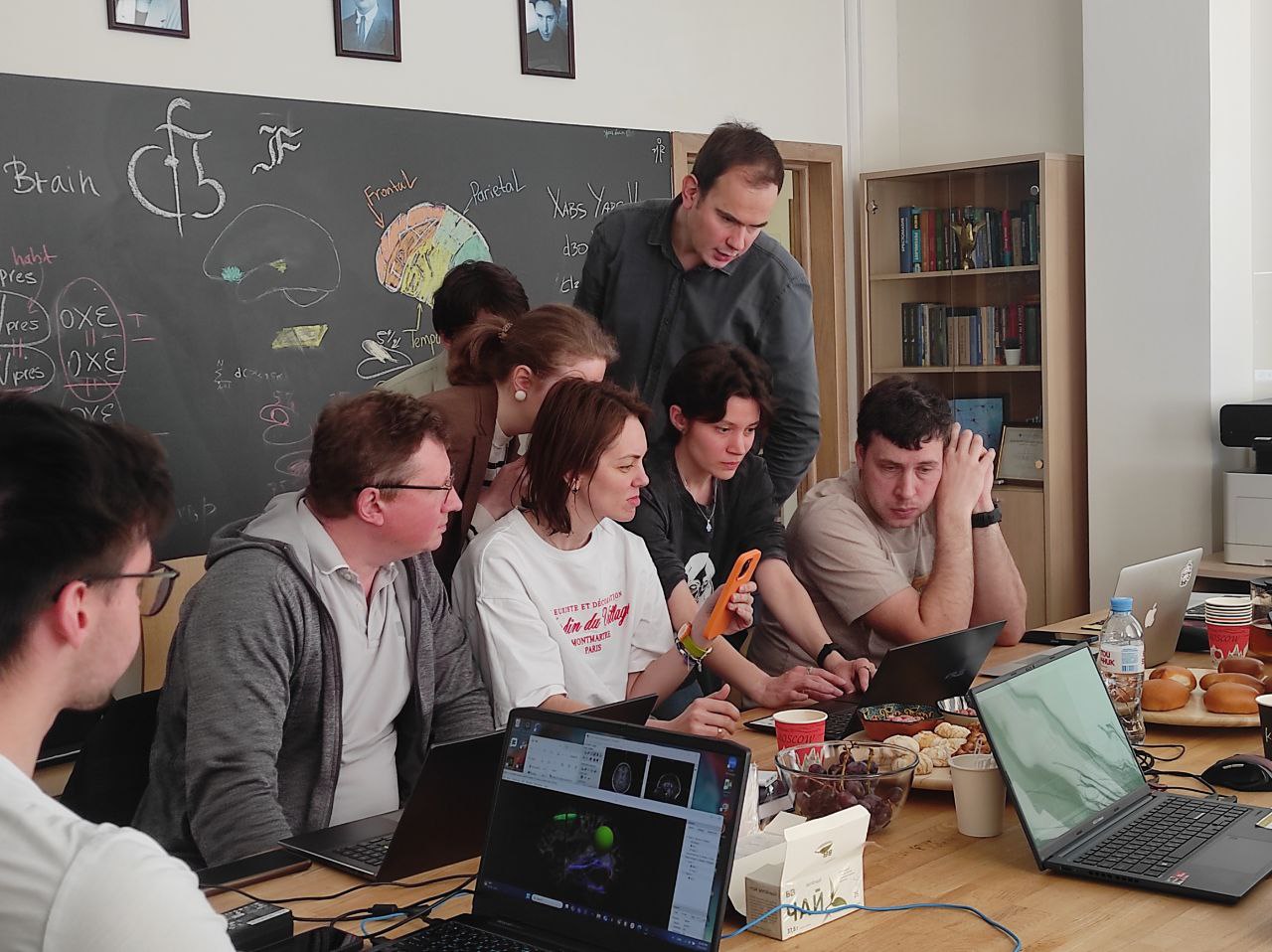
The HSE Centre for Language and Brain has extensive expertise in providing linguistic support for neurosurgical patients. An important focus of the centre’s work is the development of specialised linguistic tests to identify functionally significant language areas during the planning and performance of neurosurgical operations. The centre’s specialists are investigating how the brain’s language function reorganises in cases of tumours and epilepsy, with special emphasis on the role of white matter pathways in supporting language function. The findings are used in both research and clinical practice—during preoperative mapping and intraoperative language monitoring. The practical course generated great interest among participants and served as a platform for interdisciplinary dialogue between neurolinguists and clinicians.
Anastasia Parshunina, neurosurgeon
'During surgery, it is essential to balance the radicality of the operation with the patient’s functional status. When removing a tumour near the language area in a patient with intact language function, it is crucial that the patient retains the ability to speak and understand speech after treatment. Therefore, the ability to reconstruct tracts is essential for preoperative treatment planning and for understanding the relationship between the tumour and functionally significant structures. The course deepened our understanding of anatomical principles and demonstrated the potential of 3D modelling for preoperative planning. We are thankful to the course organisers. During the two-day course, we gained valuable theoretical knowledge and practical skills in reconstructing pathways using the TrackVis software.
The Centre for Language and Brain thanks all course participants and invites everyone to stay updated on upcoming courses and educational programmes.
See also:

Scientists Discover That the Brain Responds to Others’ Actions as if They Were Its Own
When we watch someone move their finger, our brain doesn’t remain passive. Research conducted by scientists from HSE University and Lausanne University Hospital shows that observing movement activates the motor cortex as if we were performing the action ourselves—while simultaneously ‘silencing’ unnecessary muscles. The findings were published in Scientific Reports.
Russian Scientists Investigate Age-Related Differences in Brain Damage Volume Following Childhood Stroke
A team of Russian scientists and clinicians, including Sofya Kulikova from HSE University in Perm, compared the extent and characteristics of brain damage in children who experienced a stroke either within the first four weeks of life or before the age of two. The researchers found that the younger the child, the more extensive the brain damage—particularly in the frontal and parietal lobes, which are responsible for movement, language, and thinking. The study, published in Neuroscience and Behavioral Physiology, provides insights into how age can influence the nature and extent of brain lesions and lays the groundwork for developing personalised rehabilitation programmes for children who experience a stroke early in life.
Scientists Test Asymmetry Between Matter and Antimatter
An international team, including scientists from HSE University, has collected and analysed data from dozens of experiments on charm mixing—the process in which an unstable charm meson oscillates between its particle and antiparticle states. These oscillations were observed only four times per thousand decays, fully consistent with the predictions of the Standard Model. This indicates that no signs of new physics have yet been detected in these processes, and if unknown particles do exist, they are likely too heavy to be observed with current equipment. The paper has been published in Physical Review D.
HSE Scientists Reveal What Drives Public Trust in Science
Researchers at HSE ISSEK have analysed the level of trust in scientific knowledge in Russian society and the factors shaping attitudes and perceptions. It was found that trust in science depends more on everyday experience, social expectations, and the perceived promises of science than on objective knowledge. The article has been published in Universe of Russia.
Institute for Robotics Systems Established at HSE University
As decided by the HSE University Academic Council, a new Institute for Robotics Systems will be established at HSE, and with a strong fundamental base. It will cooperate with relevant departments across the university and engage students and doctoral candidates in research and development (R&D). First Vice Rector of HSE University and Director of the Institute for Statistical Studies and Economics of Knowledge, Leonid Gokhberg, discussed the expected practical results and the framework for cooperation with an industrial partner.
HSE Seeks New Ideas for AI Agents: Initiative Competition Launched
HSE University is inviting researchers and lecturers to present concepts for new digital products based on artificial intelligence. The best projects will receive expert and technological support. Applications are open until December 19, 2025.
IDLab: Fascinating Research, Tough Deadlines, and Academic Drive
The International Laboratory of Intangible-driven Economy (IDLab) was established at the HSE campus in Perm 11 years ago. Its expertise in data processing and analysis allows researchers to combine fundamental studies with applied projects, including the development of risk and cybersecurity models for Sber. The head of the laboratory, Professor Petr Parshakov, and Senior Research Fellow Professor Mariya Molodchik spoke to the HSE News Service about IDLab’s work.
HSE Lecturers Awarded Yandex ML Prize 2025
The Yandex ML Prize is awarded to lecturers and heads of educational programmes who contribute to the development of artificial intelligence in Russia. This year, 10 laureates were selected from 300 applicants, including three members of the HSE Faculty of Computer Science (FCS). A special Hall of Fame award was also presented for contributions to the establishment of machine learning as an academic field. One of the recipients was Dmitry Vetrov, Research Professor at the HSE FCS.
HSE Tops Ranking of Universities Participating in Priority 2030 Programme
The Russian Ministry of Science and Higher Education has published an updated list of participants in the Priority 2030 programme. A total of 106 universities will receive support this year. HSE University was included in the first group and topped the ranking.
HSE University and Banking and Finance Academy of Uzbekistan Sign Memorandum on Scientific Cooperation
The partnership aims to foster academic collaboration in the fields of global economics, sustainable development, and Islamic finance. Strengthening academic ties with Uzbekistan represents a promising direction for scientific exchanges and the implementation of international projects in sustainable development.